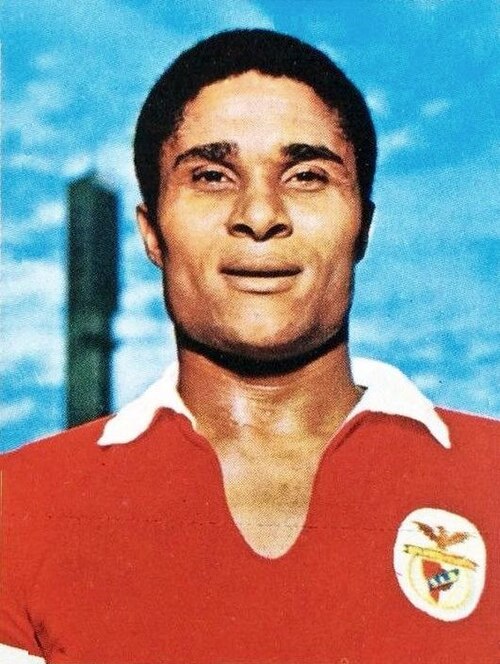
Eusébio da Silva Ferreira
Photo: Panini · Public domain
About Eusébio da Silva Ferreira
Eusébio da Silva Ferreira was born in January 1942 in Lourenço Marques, the city now called Maputo, in what was then the Portuguese colony of Mozambique. His first club was Sporting Lourenço Marques, a local branch of Sporting Clube de Portugal, and that detail makes what happened next all the more striking. When he crossed to Lisbon in the early 1960s, it was Benfica, Sporting's great rival, that secured him. He would stay there until 1975 and become the most famous player Portugal had produced.
At Benfica he was a striker of unusual power. He was fast over the first few metres, could shoot from distance with ferocious force and finished moves with either foot. He arrived as a teenager into a side that had just won the European Cup, and in 1962 he scored twice in the final as Benfica beat Real Madrid to keep the trophy. Domestic titles followed season after season, and Benfica reached several more European Cup finals during his years in Lisbon. In 1965 he was named European Footballer of the Year. For a player from Africa in that period, it was a recognition that opened doors far beyond Lisbon.
His international peak came at the 1966 World Cup in England. Portugal, at their first World Cup, reached the semi-finals, and Eusébio finished as the tournament's top scorer. The quarter-final against North Korea, when Portugal came back from three goals down and he scored four times, is still one of the most remarkable matches in World Cup history. By then the nickname that would follow him everywhere, the Black Panther, was already part of his legend.
The second half of his career is a very different picture. From 1975 onwards he moved almost every season, a reflection of knees worn down by years of punishment and of the opportunities opening up in North American football. Boston Minutemen, Monterrey in Mexico, Toronto Metros-Croatia, Beira-Mar back in Portugal, Las Vegas Quicksilvers, União de Tomar and finally the New Jersey Americans: seven clubs in four years across four countries.
Those late stops are not the reason people remember him, but they explain his place in the story of football in the United States and Canada, where his name helped attract crowds in the same period as Pelé and Beckenbauer.
Eusébio died in January 2014 and was later moved to the National Pantheon in Lisbon, an honour that shows what he meant to the country. His statue stands outside Benfica's stadium. On paper his career looks like a long, stable peak followed by a scattered epilogue. In memory it is almost entirely red, the red of Benfica.
Career Timeline
New Jersey Americans
União de Tomar
Las Vegas Quicksilvers
Beira-Mar
Toronto Metros-Croatia
Monterrey
Boston Minutemen
Benfica
Sporting Lourenço Marques
Career Statistics
Scout's notes
The clues Daily Play reveals, in order, to anyone trying to name Eusébio da Silva Ferreira.
- Clue 1Nicknamed 'The Black Panther'
- Clue 2Top scorer of the 1966 FIFA World Cup
- Clue 3Won the European Cup with a Portuguese club in 1962
- Clue 4First-ever winner of the European Golden Boot, in 1968
- Clue 5Closed out his career with several clubs across the North American Soccer League and Mexican football
Fun Facts
Test Your Football Knowledge
How well do you really know Eusébio da Silva Ferreira's career? In Daily Play, mystery players are revealed through their career timeline — clubs, dates, and country flags. The challenge is to identify the player before your attempts run out. With 9 clubs across 5 countries, Eusébio da Silva Ferreira's career makes for an easy challenge in our daily football trivia game.
Think you can guess this player?
Put your football knowledge to the test in our daily trivia game. Study the career clues and figure out who the mystery player is.
Play Now →