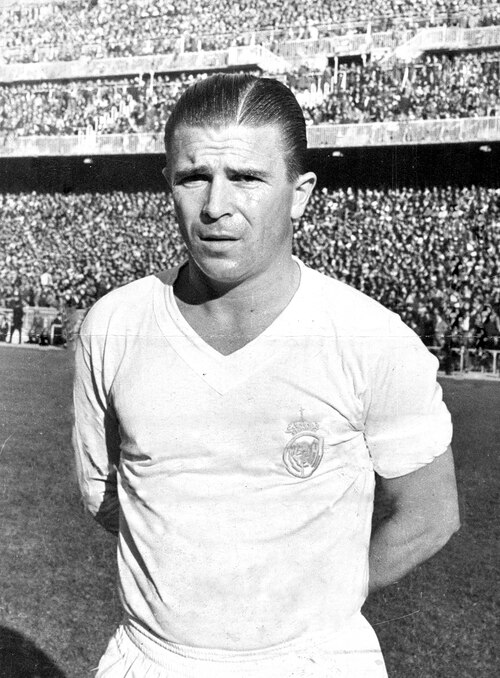
Ferenc Puskás
Photo: Unknown · Public domain
About Ferenc Puskás
There is a two-year hole in Ferenc Puskás's club career, between 1956 and 1958, and it explains more about him than any trophy. Born in Budapest in April 1927, he spent the first part of his career at Kispest, the club from his own neighbourhood that was turned into the army side Budapest Honvéd. When the Hungarian Revolution broke out in 1956, Honvéd were abroad for a European tie, and Puskás chose not to go home. A suspension followed, and for a while it looked as if one of the finest forwards of the century had simply disappeared from the game.
Before that, he had been the captain and the left foot of the Hungarian national team known as the Mighty Magyars. With Honvéd supplying much of the side, Hungary won Olympic gold in 1952, beat England 6-3 at Wembley in 1953 to end the English home record against continental teams, and reached the 1954 World Cup final in Bern, where they lost to West Germany. His army rank inside Honvéd gave him the nickname the Galloping Major.
He was short, stocky and not especially quick, and his right foot was mostly for standing on. None of that mattered, because the left could produce shots, chips and passes from almost any angle, and his reading of space in the penalty area was exceptional. As captain he was also the reference point for a side famous for interchanging positions, the player the others looked for when a move needed finishing.
When Real Madrid signed him in 1958 he was already thirty-one and well above his playing weight. Many people assumed the club was buying a name. Instead he formed one of the great attacking partnerships with Alfredo Di Stéfano and became a regular top scorer in La Liga. In the 1960 European Cup final at Hampden Park in Glasgow he scored four times as Madrid beat Eintracht Frankfurt 7-3, a match often called the finest club final ever played. Two years later he scored a hat-trick in another final and still ended on the losing side, against Benfica.
He also became a Spanish citizen and played for Spain at the 1962 World Cup, which is why he held two nationalities. He stayed at Real Madrid until 1966 and later worked as a coach in many countries.
Puskás died in 2006. Today FIFA's award for the best goal of the year carries his name, and Hungary's national stadium in Budapest is the Puskás Aréna. Two clubs on paper, Honvéd and Real Madrid, separated by exile: a short list for a forward who made both of them famous across Europe.
Career Timeline
Real Madrid
Budapest Honvéd
Career Statistics
Scout's notes
The clues Daily Play reveals, in order, to anyone trying to name Ferenc Puskás.
- Clue 1Nicknamed 'The Galloping Major'
- Clue 2Scored twice in the 1954 World Cup final
- Clue 3Won three European Cups with a Spanish club in the 1960s
- Clue 4Banned from European competition for two years after defecting following the 1956 Hungarian Revolution
- Clue 5Later became a naturalized citizen of the country where he finished his playing career
Fun Facts
Test Your Football Knowledge
How well do you really know Ferenc Puskás's career? In Daily Play, mystery players are revealed through their career timeline — clubs, dates, and country flags. The challenge is to identify the player before your attempts run out. With 2 clubs across 2 countries, Ferenc Puskás's career makes for an easy challenge in our daily football trivia game.
Think you can guess this player?
Put your football knowledge to the test in our daily trivia game. Study the career clues and figure out who the mystery player is.
Play Now →