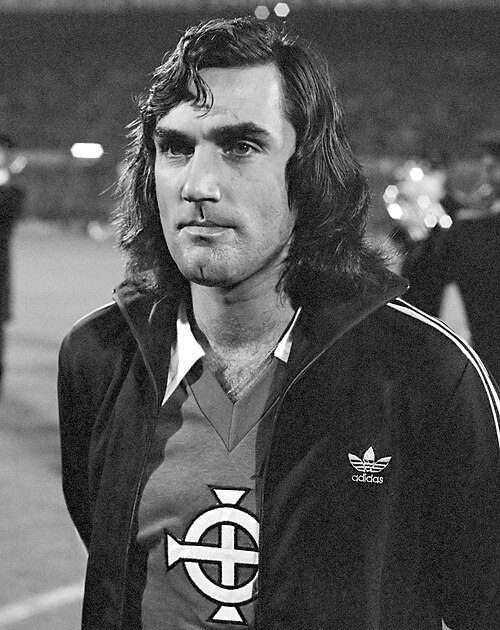
George Best
Photo: Hans Peters for Anefo · CC0
About George Best
Ten clubs in eight years after leaving Old Trafford, and yet almost everything people remember about George Best happened in red. Born in Belfast in May 1946, he joined Manchester United as a slight teenager and made his debut in 1963. Over the next eleven seasons he became the most electrifying winger British football had seen: quick, balanced, two-footed, and apparently unafraid of any full-back who tried to kick him off the ball.
The second half of the 1960s was his peak. United, rebuilt after the Munich air disaster, became champions of England and then, in 1968, the first English club to win the European Cup, with Best scoring in the final at Wembley. That same year he won the Ballon d'Or. His long hair, fashionable clothes and celebrity lifestyle earned him the nickname "the fifth Beatle", and he was arguably the first footballer whose fame reached far beyond the sport.
The decline was gradual and then sudden. As the great United side aged and the club struggled, Best's relationship with the game frayed, and by 1974 his time in Manchester was over. He was still in his late twenties. What followed was a footballer on the move, sometimes for a single season, sometimes for a few months.
In 1975 he turned out for Stockport County in the lower divisions and then crossed the Irish Sea to play for Cork Celtic. In 1976 he went to the United States, where the North American Soccer League was signing famous names, and joined the Los Angeles Aztecs. Back in London he had a spell at Fulham alongside other veteran stars of the era, then returned to Los Angeles before moving on to the Fort Lauderdale Strikers. Scotland came next, with Hibernian in Edinburgh in 1979, followed by the San Jose Earthquakes on the American west coast. His last stop was AFC Bournemouth in 1982 and 1983.
It would be easy to read that list as a sad epilogue, and in part it was, shaped by the drinking problems that he spoke about openly and that eventually cost him his health. But the wanderings also reveal how much people still wanted to watch him. Crowds in Florida, California and Edinburgh turned up for a player whose best years were already behind him, because even a fraction of George Best was worth the ticket.
For Northern Ireland he never played at a major tournament, one of football's great what-ifs. His legacy rests instead on those Manchester United seasons, where a boy from Belfast changed what a winger could be, and on a restless second act spread across four countries.
Career Timeline
AFC Bournemouth
San Jose Earthquakes
Hibernian
Fort Lauderdale Strikers
Los Angeles Aztecs
Fulham
Los Angeles Aztecs
Cork Celtic
Stockport County
Manchester United
Career Statistics
Scout's notes
The clues Daily Play reveals, in order, to anyone trying to name George Best.
- Clue 1Won the European Cup and the Ballon d'Or in 1968
- Clue 2Nicknamed 'the Fifth Beatle' for his fame off the pitch
- Clue 3Spent over a decade as a winger for a famous Manchester club before a long, well-travelled twilight in lower leagues on both sides of the Atlantic
- Clue 4Played in the North American Soccer League for clubs in Los Angeles, Fort Lauderdale and San Jose
- Clue 5Also had brief spells in Scotland and Ireland late in his career
Fun Facts
Test Your Football Knowledge
How well do you really know George Best's career? In Daily Play, mystery players are revealed through their career timeline — clubs, dates, and country flags. The challenge is to identify the player before your attempts run out. With 10 clubs across 4 countries, George Best's career makes for an easy challenge in our daily football trivia game.
Think you can guess this player?
Put your football knowledge to the test in our daily trivia game. Study the career clues and figure out who the mystery player is.
Play Now →